

Whether you’re getting married in 6 months or 2 years, this wedding planning checklist is one list that won’t stress you out.
It’s a wedding planning checklist for any kind of Indian wedding and can be used for a fusion Indian wedding too.
Use the checklist in combination with a more detailed wedding checklist [that’ll be unique to your wedding]. Keep the information organized
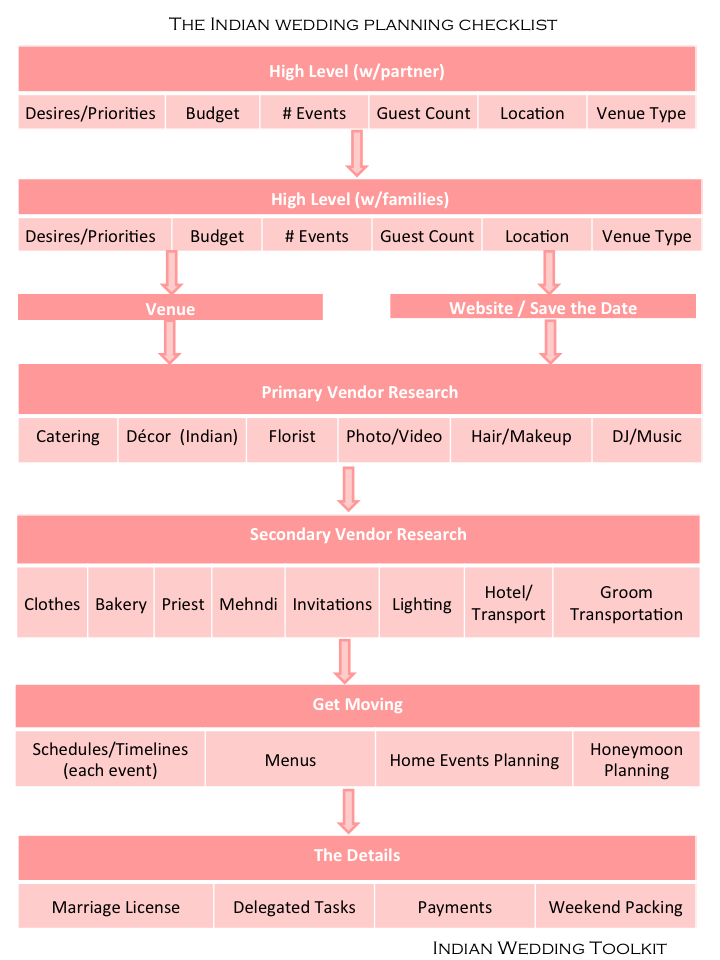
What does each partner want? Now is the time to talk about your ideal wedding, and what you both want the most.
Groom: Live music at reception
Bride: High-end food that includes cuisine from all over the world
End Result: A three-course black tie “gala” type reception with a band
This one can get complicated. Discuss who’s paying for what, are you – the couple – paying for the bulk of the wedding? Do you want to (or have to) pay for the wedding? Or are parents helping out? Don’t assume A-N-Y-T-H-I-N-G – talk about it!
Do you want the Big Fat Indian wedding? Or do you want to keep things simple with only one-pre-wedding event? It’s crucial for the couple to get on the same page before you discuss anything with families.
This one gets tricky. Discuss your desired headcount together first, then bring in the family opinions. [Brace yourself…]
Destination wedding or a local? In Bride’s hometown or where you currently live? As you discuss, think about the factors that come into play with each location.
Think high level. Do you want a venue with outdoor space? Allows outside catering? Traditional wedding hall or non-traditional space?
Now, move onto the discussing with families:
Discuss with Families: Go through each high-level step again, this time with your family.
it could be better to have a meeting with each family first, and then come together to discuss decisions.
From the outcome of the High-Level items, move onto two items.
At this point, you have enough information to look at venues that meet your needs (water view, outside catering allowed, etc).
Website / Save the Dates: Once you have your venue, date, and events, you can start building out a wedding website and explore save the dates.
TIP: As you move through the process, keep your guests in mind first. [For example: If your bapuji (grandfather) can’t climb stairs, don’t pick a vineyard in the mountains that doesn’t accommodate handicap access.]
Primary Vendors – Research: At this point, you’ll have a good understanding of what you want. Now is when you want to nail down the main vendors.
Caterers: At this stage, the important criteria are the types of menus the caterer can provide – including
breakfast,lunch, dinner and dessert, and cost per person (and kids).
Added Bonus: Check if the caterer has a history with the venue. If they’ve worked together before, you’ll likely
make out better when it comes to permits, logistics and even flexibility of options since both parties already have
a working relationship.
Decor (Mandap, linens, fabrics): Picking out a decorator was easy if you do not have a ton of requirement. What
takes longer after the initial decision is deciding what you want. Worry about picking a decorator first but check
out selections before you make a decision.
Save the details for later. What matters most is that the decorator can provide what you want and can work easily
with a florist to coordinate your design ideas.
Florist: In my opinion, there are great florists out there and there are OK florists out there. Vet florists by
checking out their designs from other weddings.
It helps when the florist has already done an Indian wedding. They know what to expect when it comes to additional
flowers for the ceremony and other small flower-related details. You may want to consider a florist who will
repurpose flowers from one event to another (makes it easier on your budget).
Photo/Video: Indian weddings require photographers/videographers who’ve already shot Indian weddings. No arguments
there.
Find someone who is willing to shoot the style you’re looking for and inquire about multiple events up front.
TIP: Don’t forget about an engagement shoot (if you want one). Many photographers will create a better package if
you decide to include engagement photos in the package.
Hair / Makeup: Getting references if very important here, so do your research. Ask about pricing by event. If
you’re getting hair/makeup done for your bridal party, now’s the time to inquire about location of services and
pricing.
Read the post on How to Pick the Right Indian Wedding Hairstyles.
DJ /Music: Here’s another place to get references. It all depends on what you want. Do you want a band one night
and a DJ another? Confirm if he/she can also serve as the MC (if you want) and if you can see them in action (at
another event).
For the DJ, inquire about Baraat services in addition to the reception (or other event). If you’re planning to
bring in a DJ or band from another city, they’ll usually require a hotel stay before the event.
Secondary Vendors – Research: Now that the main vendors are squared away, focus on next tier.
Clothes: Ah the big question – where are you going shopping? There are many options. Don’t forget about online
shopping options if you can’t travel for shopping.
Bakery: Your wedding venue might already have a preferred vendor. You can use them or choose your own.
Priest: You can outsource this task to your parents. If you’re having a fusion wedding, make sure the priest is
aware of what your events will be.
TIP: Don’t forget to get a priest who can also speak both the languages (bride and groom side). It helps when he
can explain each step of the wedding to the guests as the ceremony progresses. It also helps keep your guests
engaged.
Mehndi: Ask family and friends for references. This is the best way to find a mehndi artist because a lot of them
work by word of mouth (re: no website or way to find them online).
Invitations: There are lots of online sites to pick from – Indian and non-Indian. Once you have the event details
squared away, you can start plugging away on the invitations.
TIP: Consider online RSVPs to minimize the cost of mailing out RSVP cards (not to mention it’s easier to keep a
track of responses).
Lighting (Venue): Check with your venue about how they set up lighting. They usually have a person in charge of
lighting who you’ll work with. Ask them to set up the actual lighting for your events. Talking about lighting is a
totally different experience than seeing what the end product will be in real life.
Hotel & Transportation: If you venue isn’t a hotel, venue staff will usually have some discounts to close-by hotels.
Ask the hotel about transportation to and from the venue. Otherwise, look into shuttle services before, during and
after each event.
Groom Transportation: Whether you choose a horse, a fancy car, or another mode of transportation for the Groom to
make his grand entrance, now’s the time to research your options. Don’t forget about the vidhai (exit). If you want
to do the grand exit, you’ll need a vehicle to leave in!
Get Moving: Here’s where you want to make sure everything is jiving.
Schedule/Timeline for each event: Use google docs to work out a schedule / timeline for each event. You’ll have
help from your venue coordinator, but fill in details that he/she won’t account for.
For example, if something needs to happen between events, note that in the timeline so you can assign a [trusted]
person to complete the task.
TIP: Use Google Drive / Doc / Sheets to organize all information and to easily share it out with your family.
Check out these posts and the resources section for tips on how to organize information for wedding planning.
Menus: Check out the perfect menu for your wedding
Home Events Planning: If you’re planning to rent a tent, tables, and chairs, now’s the time to do it. You can be
creative with decorating your home for the events. Check out the resources section for shopping ideas.
Honeymoon Planning: This is a good task to outsource to your fiancée (if you want). That way, it’ll be a surprise
for you (and you’ll have time to focus on wedding planning!).
The Details – Smaller Details but Important Tasks: Here’s where you’ll be tying up loose ends before the big day.
Marriage License: It might not make sense to get your marriage license after you’re officially married especially if
you’re traveling on your honeymoon and potentially traveling back to where you live (which might be a different
place than where your wedding took place). You could get “court married” before the wedding for the sake of
convenience. Research the details in your state.
Delegated Tasks – “Day of coordinator”: For Indian weddings, it’s crucial that you have a “day of coordinator”
handling the last minute details. Whether you decide to hire a coordinator or not, you should still have that
“go-to” person who the coordinator can use as a resource. It could be your maid of honour, sister, brother, cousin
or whoever you trust to manage details over your wedding weekend.
Payments: Get payments ready ahead of time to provide vendors at your event. Delegate this task to a brother or
dad. Clearly mark envelopes with names and amounts.
TIP: Remind the groom to have envelopes of cash ready for the bride’s sisters and friends who’ll line up in front
of your vehicle during the vidhai.
Weekend Packing: This isn’t any vacation where you’re stuffing a suitcase. Now’s the time to properly pack for your
wedding weekend.
TIP: Pack one bag per event to keep each event’s clothes, jewellery and accessories organized. Include backup
options in the rare [but possible] chance you lose anything.
Other items: There will be other things to do in addition to this list as you progress through the list. Use this
checklist as a frame and then work details as you move through the process. Many of these items can happen
simultaneously after you’ve secured your vendors.
Other considerations that get overlooked:
Expectations and Compromising: While you go through this process, keep in mind that parents and other family
members will have certain expectations around your wedding. Try to level set the expectations from the beginning.